Please visit my website:

Thursday, April 29, 2010

Today's Word: JUDAICA


Judaica is the term that categorizes all items related to Judaism. The obvious items would be those used in religious ceremonies, such as Hanukkah Menorahs, prayerbooks, Hebrew or Yiddish engraved items (such as spice boxes) and printed ephemera ... basically anything relating specifically to Jewish life and rituals. Often the term is misused when describing items related to to everyday life in Israel, such as national symbols, militaria collectibles, or Israeli advertising memorabilia. These are known as Israeliana.

Tuesday, April 27, 2010

Today's Word: LAMPWORK


The term "lampwork" comes from the process of making small objects from glass rods and canes, using a small torch, or "at-the-lamp." While this technique dates to the 1st century, it became a popular art form in Murano, Italy in the 14th century. Lampwork is the process used in the production of glass figurines, trinkets, Christmas tree ornaments, and beads. In the mid 19th century France, lampwork was applied in the production of paperweights.

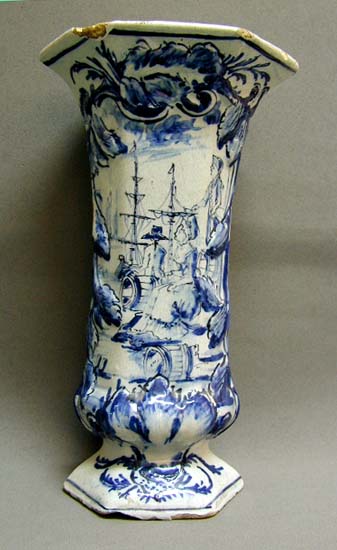
Today's Word: DELFT


Delft (Delftware) is the blue and white pottery made in and around Delft, as well as the tin-glazed pottery made throughout the Netherlands, from the early 16th to the 18th century. While the Dutch had long been admirers of imported Chinese blue and white porcelain, they only began producing Chinese patterns in the early 17th century, when imports to Europe were suspended due to the death of Chinese Emperor Wanli. From the mid-17th century, Dutch potters began signing their work with monograms and factory marks.

Monday, April 26, 2010

Today's Word: CRYSTOLEUM


The crystoleum (chromo-photograph) was basically an albumen photograph placed face down on a concave glass and the paper backing removed, leaving only the emulsion stuck to the glass, which was then made transparent by using a wax or oil, and when only the outlines were visible, the once-photo was partially hand painted. Another curved glass was placed behind the first glass (and the partially painted picture), and larger parts of the painting were then filled in on the second glass. This double-glass painting created an almost 3-D image. Crystoleum-making was popular in England from the second half of the 19th century till World War I, and while many were produced, only a few survive.

Saturday, April 24, 2010

Today's Word: FERRONIERE


A ferronière is a band worn across the forehead, often set with a single center stone. Why is it called a "ferronière"? Well, it seems that a 15th century painting (attributed to Leonardo da Vinci) of an unknown woman (who is wearing a jeweled band on her head) was eventually named "La Belle Ferronière" in the 17th century, and that's how the headband got its name.

Friday, April 23, 2010

Today's Word: FOB


There is some confusion as to what a fob actually is. Some are convinced that it's the chain that attaches to a pocket watch on one end and a to man's waistcoat on the other. Others will tell you it's the waistcoat pocket itself. And yet others will argue that a fob is the small (and often useful) ornament attached to the watch chain. Actually, it can be all three: chain, pocket, and ornament. The word originated in the mid-17th century, probably a derivative of the word Fuppe, a German dialect word for "pocket."

Thursday, April 22, 2010

Today's Word: ESCUTCHEON


This strange-sounding word has many common applications that we are all familiar with, but perhaps never knew the name for: For one, an escutcheon is the shield shape where a heraldic coats of arms is often displayed. It is also the term used for the metal plate (not necessarily shield-shaped) around a keyhole on a door, a piece of furniture, or a box. Yet another escutcheon is the metal plate on a ship, inscribed with the vessel's name. A more familiar escutcheon may be the decorative plate around the faucet of your bathtub.