Please visit my website:

Monday, November 7, 2011

Which Description is Correct?


So, we have a choice of two possibilities for this two-sided pendant ... The scene on one side is of an Eagle holding 2 flags, and a banner that says: E PLURIBUS UNUM (sound familiar?). The other side is what seems to be a mountain scene within a frame and flanked by red, yellow and green ribbons. I don't know what's perched on top. A bird? The eagle is made of feathers, as are the ribbons and flags. The banner and other elements are paper. The pendant measures 1 1/4" in diameter.

Which would you say is correct ... A or B?

A. Commemorative victory piece made during or right after the Spanish-American War dating 1898-1900. The use of feathers and foil confetti is consistent with the post Victorian era. The flag on the right is the Havana flag, signifying victory over that Spanish force, and the flag on the left is Mexican, reminding Americans of our victory in the Mexican-American war of 1848.

B. A piece commemorating the Organization of American States (Pan-American Treaty) which occurred during the late 19thC.

I'm B-a-a-c-k!

Hi Followers,
It's been a while, but I've gotten my act together and will continue updating this blog with interesting antique tidbits. Hope you haven't forgotten me.
Stay tuned ...

Thursday, May 6, 2010

Today's Word: BOCAGE


The word "Bocage" derives from the French "bosc," meaning "wood." In antiques, bocage is the name for the mass of leafy and flowery shrubs or branches which were popular decorative additions to 18th century porcelain figures.

Tuesday, May 4, 2010

Today's Word: NECESSAIRE


One doesn't have to be Einstein to figure out that "Necessaire" is somehow related to the word "necessary." A Necessaire (French) is a small case that contains all the tools NECESSARY to get a job done. For instance, a sewing necessaire would contain the basic tools for mending something, and a writing necessaire would have a pencil/pen, paper, and often other little accessories.

Monday, May 3, 2010

Today's Word: MEERSCHAUM


From the German for "sea foam," Meerschaum is a soft white mineral found mainly in Turkey, but also in lesser quantities in France, Spain, Morocco, and in some U.S. states. Used mainly for making smoking pipes and cigarette holders (in Vienna and other European manufacturing centers), it was often intricately carved, with figural heads forming the bowl of the pipe. It was also used, to a much lesser extent for carving decorative figurines. In the 1970s, Turkey banned the export of Meerschaum, and today, Meerschaum products not made in Turkey are usually made of pressed Meerschaum and are of inferior quality. With use, Meerschaum pipes gradually change color, and turn yellow, orange, or a reddish brown.

Saturday, May 1, 2010

Today's Word: ANIMALIERS


The Animaliers (Les Animaliers) is the name bestowed upon the mid-19th century group of French sculptors who specialized in creating naturalistic sculptures of animals in bronze. Leader of the school was Antoine-Louis Barye, and one of the most well-known among the Animaliers was Pierre-Jules Mene.

Friday, April 30, 2010

Today's Word: BRUSH POT


A brush pot is exactly what you might think it would be. A pot (well, actually a cylindrical, unlidded container) for holding Chinese and Japanese artists' and calligraphers' pens and brushes. Most often they are of made of either pottery, or bamboo. Dating to around the 16th century, they are still being made for use today.

Thursday, April 29, 2010

Today's Word: JUDAICA


Judaica is the term that categorizes all items related to Judaism. The obvious items would be those used in religious ceremonies, such as Hanukkah Menorahs, prayerbooks, Hebrew or Yiddish engraved items (such as spice boxes) and printed ephemera ... basically anything relating specifically to Jewish life and rituals. Often the term is misused when describing items related to to everyday life in Israel, such as national symbols, militaria collectibles, or Israeli advertising memorabilia. These are known as Israeliana.

Tuesday, April 27, 2010

Today's Word: LAMPWORK


The term "lampwork" comes from the process of making small objects from glass rods and canes, using a small torch, or "at-the-lamp." While this technique dates to the 1st century, it became a popular art form in Murano, Italy in the 14th century. Lampwork is the process used in the production of glass figurines, trinkets, Christmas tree ornaments, and beads. In the mid 19th century France, lampwork was applied in the production of paperweights.

Today's Word: DELFT


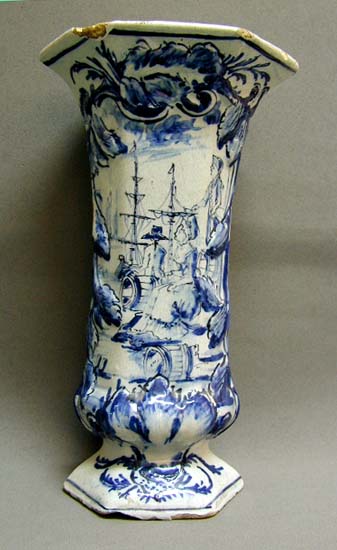
Delft (Delftware) is the blue and white pottery made in and around Delft, as well as the tin-glazed pottery made throughout the Netherlands, from the early 16th to the 18th century. While the Dutch had long been admirers of imported Chinese blue and white porcelain, they only began producing Chinese patterns in the early 17th century, when imports to Europe were suspended due to the death of Chinese Emperor Wanli. From the mid-17th century, Dutch potters began signing their work with monograms and factory marks.

Monday, April 26, 2010

Today's Word: CRYSTOLEUM


The crystoleum (chromo-photograph) was basically an albumen photograph placed face down on a concave glass and the paper backing removed, leaving only the emulsion stuck to the glass, which was then made transparent by using a wax or oil, and when only the outlines were visible, the once-photo was partially hand painted. Another curved glass was placed behind the first glass (and the partially painted picture), and larger parts of the painting were then filled in on the second glass. This double-glass painting created an almost 3-D image. Crystoleum-making was popular in England from the second half of the 19th century till World War I, and while many were produced, only a few survive.

Saturday, April 24, 2010

Today's Word: FERRONIERE


A ferronière is a band worn across the forehead, often set with a single center stone. Why is it called a "ferronière"? Well, it seems that a 15th century painting (attributed to Leonardo da Vinci) of an unknown woman (who is wearing a jeweled band on her head) was eventually named "La Belle Ferronière" in the 17th century, and that's how the headband got its name.

Friday, April 23, 2010

Today's Word: FOB


There is some confusion as to what a fob actually is. Some are convinced that it's the chain that attaches to a pocket watch on one end and a to man's waistcoat on the other. Others will tell you it's the waistcoat pocket itself. And yet others will argue that a fob is the small (and often useful) ornament attached to the watch chain. Actually, it can be all three: chain, pocket, and ornament. The word originated in the mid-17th century, probably a derivative of the word Fuppe, a German dialect word for "pocket."

Thursday, April 22, 2010

Today's Word: ESCUTCHEON


This strange-sounding word has many common applications that we are all familiar with, but perhaps never knew the name for: For one, an escutcheon is the shield shape where a heraldic coats of arms is often displayed. It is also the term used for the metal plate (not necessarily shield-shaped) around a keyhole on a door, a piece of furniture, or a box. Yet another escutcheon is the metal plate on a ship, inscribed with the vessel's name. A more familiar escutcheon may be the decorative plate around the faucet of your bathtub.

Wednesday, April 21, 2010

CELLULOID


A highly flammable plastic-like substance, Celluloid was invented in the mid-19th century, and used as an ivory substitute in making everything from picture frames and fans to toiletry items and jewelry. Ivory colored celluloid with striated lines, is known as "French Ivory." Celluloid is still used today to make items like ping-pong balls and guitar picks. You can test celluloid by rubbing it. It should give off a distinctive camphor odor (like mothballs).

Tuesday, April 20, 2010

Today's Word: SASSANID JEWELRY


Sassanid jewelry was made during the last dynasty of the native rulers (the Sassanidae) of ancient Persia - from 224-642 AD - during the Sassanid era, and for two centuries thereafter. One of the more popular types of jewelry of the period was the intaglio seal, etched with animals, monsters, and birds, and set into swivel rings.

Monday, April 19, 2010

Today's Word: ELEPHANT HAIR JEWELRY


Believed by the Indians to bring good luck, elephant hair was a popular material used as inlays in rings and bracelets in the 1800s. In England of the latter part of the Victorian era, these rings became a popular jewelry item for men.

Saturday, April 17, 2010

Today's Word: FINIAL


Finials in architecture are ornamental elements that decorate the top or corner of a structure. While originally used purely for ornamental purposes, such as at the tops of bedposts and chairs, or on flagpoles, smaller finials are also used to serve practical purposes, such as the decorative screws that hold lampshades on lamps, or as ends of curtain rods which keep curtains from sliding off.

Friday, April 16, 2010

Today's Word: INGOT


An ingot is usually a pure metal (most often gold, silver or steel) that is cast into a shape that would make it easy for future processing. Ingots are manufactured by pouring a molten liquid into a mold and then freezing it. The freezing maintains the physical properties of the material. The most common shape is a rectangular bar, which has been used as a theme in jewelry - mainly charms. Pictured here is a miniature "ingot" set in ring with a diamond surround.

Thursday, April 15, 2010

Today's Word: ORMOLU


Ormolu, from the French for "ground" or "beaten" gold, is a gold leaf used in gilding another metal. It is also the term used for metal itself (usually bronze) that has been gilded. The technique for producing ormolu are basically the same as that of silver-gilt, or vermeil (see earlier post). Ormolu (though the word came into use in 1830), has been around since antiquity.